A small steel ball B is at rest on the edge of a table of height 1m. Another steel ball A, used as the bob of a meter-long simple pendulum, is released from rest with the pendulum suspension horizontal & swings against B as shown in figure. The masses of the balls are identical & collision is elastic.
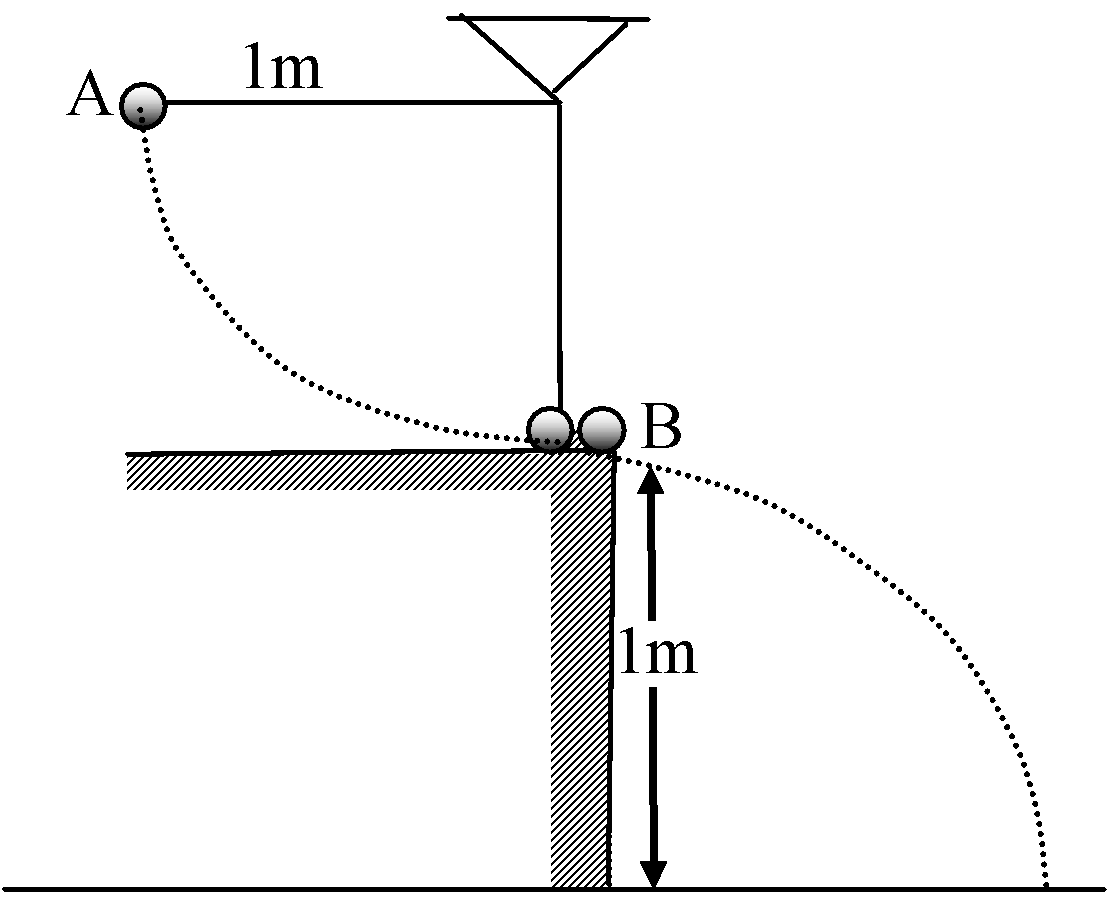
Considering motion of B only up until the moment it first hits the ground.
(i) Which ball is in motion for longer time.
(ii) Which ball covers greater distance.
Text Solution
Verified by ExpertsCHECK THE SOLUTION.
Sol. (i) The vertical acceleration of ball B falling from the table is always g, which makes it possible to determine the time (approximately half a second) it takes to fall 1m. The motion of the bob of the simple pendulum is rather complicated as no small amplitude approximation is possible, and therefore the time during which it it is in motion is not easy to determine. What can state with certainty is that, since the thread exerts an upwards force on it, its vertical acceleration is always less than g. Therefore, the vertical motion of ball A takes a longer time than the vertical free fall of ball B. Ball A stays in motion for longer. (see figure below)
For ball A: For ball B:


mg – Tcos  = ma A
a B = g
a A = g –  cos
cos 
since a B > a A ; ball B remains in motion for smaller time.
(ii) The bob of the pendulum describes one-quarter of a circle (a path of approximately 1.5m). The other ball, B follows a parabolic path, the length of which cannot be determined by elementary method. However, it is easy to see that it hits the ground at a distance of vt =  = 2m from the edge of the table. The length of its path is therefore not less than the shortest distance between the beginning and end points of its motion, namely
  m
m  2.2m.
2.2m.
Prepare Smarter with CGP Edu
Get practice questions, solutions, and test series in one place.
Write a Review
Share your experience with this question and solution.
Commentary
Send your comment, doubt, correction, or feedback to admin.
Similar Questions
Explore conceptually related problems